Showing posts with label Christiana Elizabeth Goheen. Show all posts

Thursday, May 18, 2017

Dorinda Melissa Moody - My GGG Grandmother

Pine Valley Utah.  I had never heard of Pine Valley until I read my great great great grandmother, Dorinda Melissa Moody Salmon Goheen Slade's history.  She is related to me through Than Cooper's father.  She is his grandmother's mother. See Cooper Family line here. Or see Cooper Family blog entry.

When I was growing up and I asked my mom about Grandpa (Than) Cooper's family, she told me she didn't know anything.  Later I learned that this branch of the family had a very interesting story.

Dorinda was born to John Wyatt Moody and Mary "Polly" Baldwin on January 15, 1808 in Iredell, North Carolina.  As the oldest of six children it was her responsibility to care for her younger siblings while her mother helped in the fields. Dorinda spent much of her time spinning, weaving and doing handwork at which she became very proficient.

When Dorinda was 17 she met and married William Gidson Salmon. They had 3 children. Three years after they were married, her daughter Margaret died of membranous croup William was away on business quite a lot of the time and on one of his trips, he died from drinking poisoned whiskey. He was buried before word of his death got back to Dorinda.  As a widow with 2 small children, she found work as a domestic helper then began supporting her family by selling her handwork. Soon she moved to Texas to be near her parents.  Her father died shortly after. 

In Texas, Dorinda met and married Michael Roup Goheen in 1837.  They lived on a cotton plantation and owned slaves and servants.  They also owned dairy cows and had a large herd of Texas Longhorns. She and Michael had six children.


Dorinda taught the children spelling, arithmetic, geography and history in their home and sent them to live with families in town when they were 9 or 10 so that they could attend school.

As was the case years ago, many families lost family members to illness and death. Dorinda's first loss was her daughter Margaret. The next was her third daughter (Margina) who died at age 13.  A year later her oldest daughter, Philina along with her newborn twins died.  Her first three children from Gidson Salmon were now gone.


In 1850 LDS missionaries taught Dorinda and Michael about their religion.   The missionaries were going to be gone for a few weeks, so they decided to be baptized after Michael returned from selling their cattle at Spring Creek.  While he was there, he died of a congestive spell and was buried several days before word of his death got back to Dorinda.  Six weeks after his death, she was baptized into the Church of Jesus Christ of Latter-Day Saints.

Her mother and brother also were baptized a short time later.   Two years later they decided to leave Texas and "gather to Zion" with others of their faith.  Dorinda freed her slaves and sold her property, but she decided to take her herd of Texas Longhorn cattle and other livestock with her.  Dorinda married a widower, William Slade who had several children of his own, to help each other travel to Utah.  Dorinda and her daughter and son-in-law joined a wagon train to Utah.  Dorinda was then forty-five years old, with a family of eleven children.

This group of pioneers drove their animals from Texas to Utah.  It was a long and difficult journey. They had not traveled very far before Dorinda's only son, age 3, died of illness and was buried on the border of Texas and Oklahoma.  They spent three years in the Cherokee Nation in Oklahoma as part of this journey.  They arrived in the Salt Lake Valley on September 17, 1856 and settled in Ft. Herriman near her daughter Eliza.

A year later they were called to settle the Cotton Mission in southern Utah. Her daughter Eliza and husband were also part of the group that was called.  Before they left, she and William were remarried and sealed in the Endowment House in Salt Lake.  One history I read said that as they were traveling to the St. George area, she was looking forward to seeing her daughter Christena (Seguine) Cooper who she had not seen in 8 years.

They settled in Washington, Utah for a time where they grew cotton and raised silk worms.  They were then called to moved to Pine Valley so that William could work in the sawmills there.  At one time, there were 4 sawmills in Pine Valley.  This was Dorinda's last move. They built a log cabin up near the mountains.  She planted apple trees out back
Dorinda's Home in Pine Valley
and had beautiful roses growing in front of the house.  Her husband had taken an active part in community affairs.  He was the Justice of the Peace in Washington and then Pine Valley.  He made his living growing apples and hauling lumber to Panaca, Nevada.  It was on one of these trips to Panaca that Mr. Slade died.  He was buried there in 1872.  It is strange that all three of Dorinda's husbands died while they were away from home and were buried before she ever got word.
She was left a widow at the age of 64. She spent her time making quilts and bed spreads, netting window curtains, sewing and making her dresses all by hand. She served as Relief Society President for 14 years in Pine Valley. 

Dorinda was an incredible quilter.  All of her work was done by hand.  A signature of her 
work was that she did not bury her knots in the batting, but left them exposed on the back.  One of her quilts took first prize at the Chicago World Fair and she received a sum of $50 for her award. This was a lot of money in those days. Three of her most beautiful quilts came from the last years of her life:  the "World's Fair", "Window Pane," and "Hanson Sunburst" quilts.  
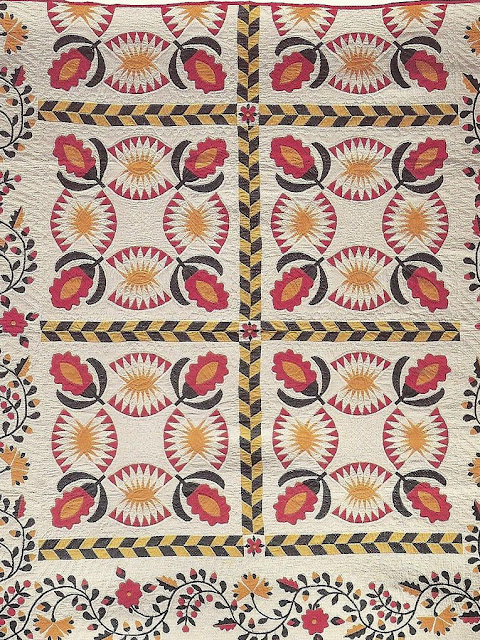
Dorinda made the "Sunburst Quilt" at the age of 84
 
This quilt, "Sunrise in the Pines," was created and made for her brother as a wedding gift.  It contains more than 3,400 pieces and was hand-dyed and hand-pieced.  It is on display at the Daughters of Utah Pioneer Museum in Salt Lake City, Utah.
Book about Dorinda Slade


In the winter of 1894-95, she walked out to feed her chickens in the barn across the road and broke her left arm and hip.  She never recovered from that injury.  She was bedridden for a year and died at the age of 86 (nearly 87) on November 21, 1895, at the home of her daughter, Eliza Lloyd.  She was buried in the Pine Valley Cemetery.


Note:  Grandpa Cooper was born in 1892, 3 years before his GG Grandmother died.  His father James Michael Cooper was born in 1861 and died in 1905, ten years after Dorinda.  


There is a beautiful little church in Pine Valley that is one of the longest continuously used chapels in the LDS church and has been used since 1868.  The church was designed by Ebenezwer Bryce who discovered Bryce Canyon.  The church is built like an upside down ship.

Wood for the Salt Lake Tabernacle organ pipes were taken from large yellow pine trees from Pine Valley. They were cut into 30 foot lengths and hauled by wagon to Salt Lake where they were fashioned into organ pipes.

Pine Valley is 35 miles north of St. George.

Thursday, July 12, 2012

Christina Goheen, Grandmother of Than Cooper, Mother of James M. Cooper

Christina* Goheen was born on September 9, 1841 in Spring Creek, Harris County, Texas.  Her parents were Michael Roup Goheen and Dorinda Melissa Moody.
They lived on a cotton plantation with slaves and servants.  They also owned dairy cows and a large herd of Texas Longhorns.  Her mother, Dorinda taught the children spelling, arithmetic, geography and history in their home.  When the children were around nine and ten years of age, they would go to live with families in town so they could attend school.
In 1850, LDS missionaries taught Christina's parents and presumably the family about their religion.  The missionaries were going to be gone for a few weeks so they decided to be baptized after her father, Michael returned from selling their cattle in Spring Creek.  This was in the early part of June.  Her father never returned from that trip.  While he was gone, he died of a congestive spell on June 16, 1850.  He had been buried several days when the news reached the family.  Christina would have been about 8 years old (not quite 9) at the time of her father's death.

Six weeks after her father died, her mother was baptized into the Church of Jesus Christ of Latter Day Saints by Preston Thomas and James McGow.  Two years later the family was making plans to move to Utah to be with the others of their faith.  Christina's mother freed her slaves and sold her property.  Her mother married a widower, William Slade who had several children of his own, to help each other travel to Utah.  They started their journey In the early part of 1853.

The Mormon Pioneer Overland Travel database lists say that Christina was 14 when she came to Utah and that she was in the "Jacob Croft Company."  This group of pioneers drove their cattle (Texas Longhorns) from Texas to Utah.  It was a long and difficult journey.  She spent three years in the Cherokee Nation in Oklahoma from 1853 to 1856 as part of this journey.  She was ages 12 to 15 during this time as it took nearly 3 years to get to Utah.    

Christina married Seguine Cooper whose family was also from Texas on March 3, 1857.  They were married in Salt Lake City and endowed in the Endowment House in Salt Lake City.  Family Search shows records for her being baptized and confirmed on March 16, 1857.  Perhaps she was baptized a second time, which was a common practice in the early days of the Church. 

One history I read said that after she and her husband were called to settle the Muddy Mission, and were traveling to the St. George area, she was looking forward to seeing her mother as she had not seen her in 8 years.    

For the rest of her history see the post about her husband, Seguine Cooper.  It details their moves from one settlement to another and the births of their children.

Christina died on August 24, 1892 and is buried in the Panguitch Cemetery.  She died the day after her grandson, Than Cooper (my grandpa) was born.  He was born August 23, 1892.

*I have seen several different spellings of Christina Goheen's first name.  I am not sure if her name is Christina, Christine, or Christiana.

Tuesday, July 3, 2012

Seguine Cooper, Grandfather of Than Cooper, Father of James M. Cooper

Sometimes there is not much information on a particular ancestor.  Such was the case of Seguine Cooper.   The following history was pieced together from reading about members of his family.  A great amount of information was obtained from reading the history of his daughter, Mary Ophelia.  When my mother died, I found a book she had in her possession called, From Texas to Utah, The Pioneer Story of James Cooper and Hannah Cornog by J. Daniel Marshall.  I was very excited to find and read this history. 

Seguine Cooper was born November 27, 1837 to Hannah Cornog and James Cooper in Spring Creek, Harris County, Texas.  He was James Cooper’s  only child.  His mother, a widow, had seven other children:  She had four surviving “Goaslind” children by her first marriage.  From her second marriage, Hannah had three living “Miller” children.

Spring Creek, Texas is about 20 miles north of Houston.  Seguine’s father was a rancher and farmer who owned hundreds of acres.  They were quite well off financially.  They had city property in Houston, and tracts of land in Harris and Montgomery Counties.

Seguine was in his teens when an Elder James McGaw and other Mormon missionaries were in the area.  Seguine’ father and mother were baptized in 1851.  Other members of the family were baptized the same year. 

By 1853, there was growing opposition to the Mormon Church in Texas.  The Cooper family as well as other LDS families in the area made plans to travel to Utah.  Some of the members wanted to travel across the land, a distance of approximately 2,000 miles and take their cattle with them.  They planned to travel north following a trail where they could feed and water the cattle, until they reached the Mormon Trail.  Seguine's father, James Cooper thought that it would be better to take a steamboat up the Mississippi River.

In the early spring of 1853, the Cooper family gave up all their possessions in Texas, and left for Utah. They traveled across the Gulf of Mexico on board a steamship called the “Louisiana.”  They arrived in New Orleans on April 5, 1853.  From there they went by steamboat, the “L.M. Kennet”  to St. Louis.  The Coopers traveled to Kansas City by way of the Mississippi River.  There they joined the "Moses Dailey Company".  James and Hannah Cooper’s other family members and friends traveled to Utah with the "Preston Thomas Company," driving cattle from Texas to Utah.  The Coopers probably arrived in Utah in September of 1853; some of their family members and friends arrived a year later and others arrived 3 years later.  

The family settled in Ft. Herriman, west of the Jordan River, in the Salt Lake Valley.  They lived in a little log house on a few acres of land.   

He married Christina Elizabeth Goheen, a long time friend of the family, on March 31, 1857. When Johnson’s army threatened them, they moved to Salem, Utah.  The first daughter, Mary Ophelia was born there.  Later they went back to Ft. Herriman.  In 1863, he was called to go east to help a wagon train of Saints move to Utah.  Three children were born to Seguine and Christina while the family was living in Ft. Herriman:  Seguine Goheen in 1858, James Michael (our ancestor) in 1861, and Dorinda Christina*  in 1863. Seguine’s grandmother, Hannah Cornog Cooper, also lived with them since her husband died in 1860.   

In 1866, James’ family was called to settle the St. George area.  Many families who had come from the Southern States were called south to the “Cotton Mission” because they knew how to raise cotton.  The Cooper family was originally called to settle the ”Muddy Mission” beyond St. George, near present day Las Vegas,Nevada.


They left their home in Ft. Herriman taking only their family and what supplies they could haul in two wagons.   The wagons pulled by six oxen, were loaded with their belongings, seed for planting, and enough food to last a whole year.

The Coopers traveled with several other families who were also called south.  Seguine drove a covered wagon pulled by four oxen while his daughter Mary drove the lighter wagon pulled by two oxen.  Mary drove this second wagon because her mother was expecting their fifth child any day.

When they reached the settlement of Beaver in November 1866, Christina delivered a baby boy they named Levi.  They waited a few days before continuing their journey.

They continued on traveling south from Beaver to St. George.  Christina looked forward to seeing her mother who lived in Washington, Utah.  She hadn’t seen her mother for eight years.  The children had never met their grandmother, Dorinda Moody Goheen Slade.  The family stayed there for a few days before moving on.

The Cooper family traveled to St. George and found out that their call to the “Muddy Mission” was changed.  They were now to travel about a week’s journey to the north until they reached a new Mormon settlement of Panaca which was located about 90 miles west of Cedar City, Utah.  Two children were born in Panaca:  Eliza Jane in 1868, and Hannah Melissa in 1870.

Panaca was originally settled by Mormon families six months before Nevada became a state.  Soon there were miners in the area.  There were some problems between the miners and the Mormons and also with the Indians.  The state line for Nevada had been changed putting Panaca in the State of Nevada rather than Utah.  Nevada wanted the taxes that had been paid to Utah up to that time.  The taxes were high and the settlers were unable to pay.  After living in the Panaca area for five years, the Cooper family left to settle one of the communities in Southern Utah.

In 1871, Seguine Cooper left his family in Panaca and drove his wagon to the Panguitch Valley arriving in April.  He made preparations for his family to move there.  He then returned to Panaca to move his family, his livestock and what possessions he could fit into a wagon.  It took about a week to travel from Panaca to Panguitch.

When the family arrived in Panguitch on August 10, 1871, there had been a hard frost the previous day.  His wife and mother saw everything frozen and expressed their doubts about living at that high elevation. 
The elevation of Panguitch is 6,700 feet. They also thought that since Panguitch was on the north side of the mountains, it would be colder.  The women were concerned about the area being too cold to raise good crops, but Seguine told them to look at the range available for livestock.  There were lakes and streams for fishing and much wildlife in the area.  He convinced them to settle in Panguitch.   Seguine’s job in the community was that of fisherman.

At this time, the Cooper family consisted of Seguine, his wife and mother, and seven children.  The first year they lived in Panguitch, they lived in the Panguitch Fort located on the corner where the high school now stands.  The fort and stockade were made of long posts set closely together.  The houses built inside the fort faced the center, and each house had holes cut in the back walls, large enough to shoot a rifle through.

In the spring of 1872, the Cooper family, now totaling ten people, moved out of the fort and into a little log house several blocks away.  The house had only one large room, a board floor, no rugs, and no ceiling.  It was cold in the winter, so the fire was kept burning day and night for months.  Apples and potatoes not taken back to the cellar at night were frozen so hard the next morning that they couldn’t be used until they were thawed by the fire.

Their meals consisted mainly of meat, potatoes, molasses, dried peaches, and milk.  In the summertime they often ate wild dandelion greens and pig weed greens with their meals.  During the winter of 1877-78, the people in Panguitch had a hard time feeding their families.  They lived on such foods as wild wheat, barley, potatoes, squash, onions, corn, and beans.  Dried corn, ground and boiled before serving, was called hominy.

Clothes were also scarce during the winter.  Most of their clothing was worn out, so pants for the children were made from flour sacks and other sacks.  The lack of food and clothing made life tough.


Seguine Cooper's house in Panguitch was located a block west of Main Street.  It later became the location of the J. Scott Haycock home, and eventually the Kirk Moore home.

In 1873, some Panguitch people began to homestead land at Panguitch Lake.  Seguine built a cabin on his homestead at the lake.  The Cooper cabin was near the east shore of the lake at the foot of what is now known as “Cooper Peak,” although it is labeled as “Cooper Knoll” on today’s Forest Service map.  The cabin stood in a more level area, now usually covered with water, which is south of where the Lake View Resort now stands.  In the early days, very few people tried to live at the lake year round.  It was extremely cold at night with temperatures often reaching about 35 degrees below zero.  Snow drifts could reach up to eight feet deep.  
Sleeping outside on the ground or in a wagon was then very common, even in town.  This wasn’t sleeping out for recreation as much as it was a lack of room indoors, and it wasn’t limited to the summer season. The family consisted of Seguine, his mother, his wife, and ten children. Three children were born in Panguitch:  Amanda Fredonia in 1873, John Harvison in 1876, and Nathan Cooper in 1879.

Photo by A. Bell - Findagrave.com
Seguine Cooper died on September 16, 1899 in Panguitch and is buried in the Panguitch Cemetery.  

 *All of Seguine and Christiana's children are buried in Panguitch except their daughter, Dorinda.  Where she is buried, is unknown. See Dorinda for blog post about her story.


Information taken from book, From Texas to Utah, The Pioneer Story of James Cooper and Hannah Cornog, by J. Daniel Marshall.